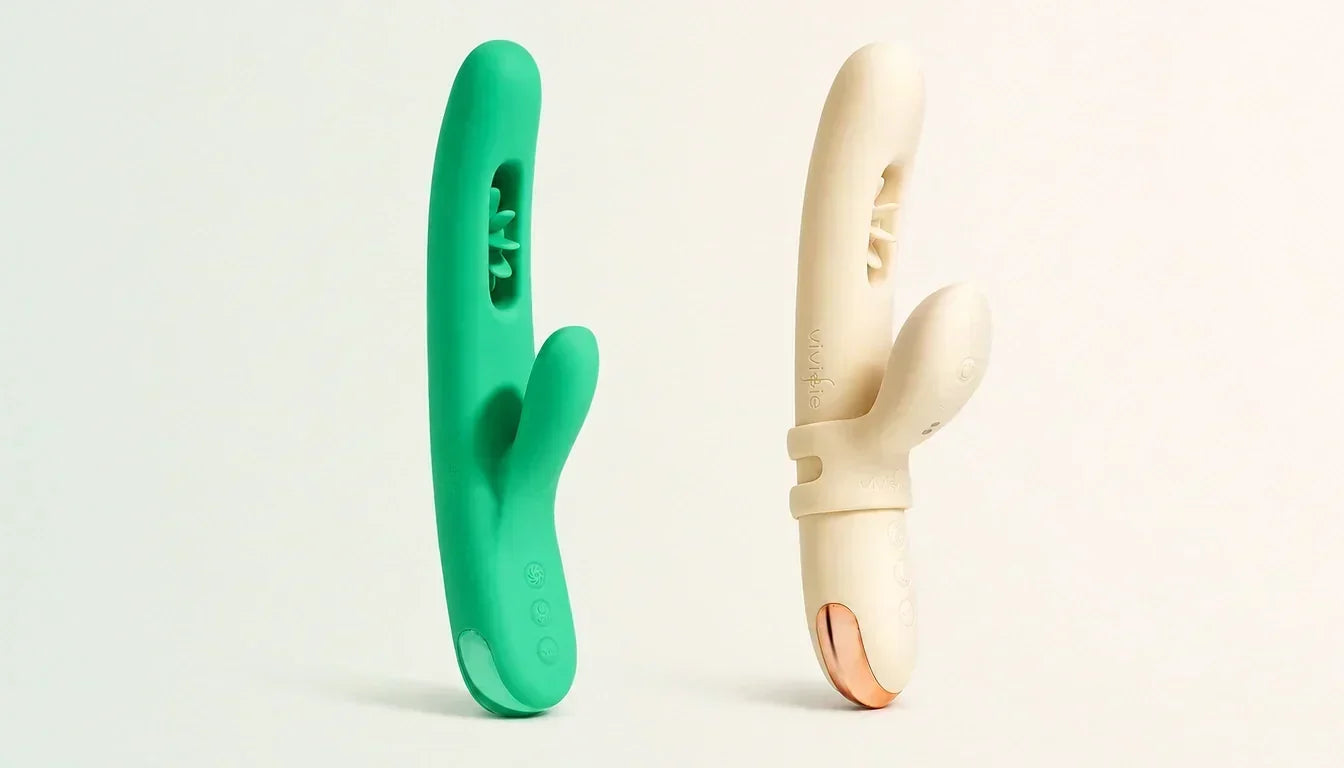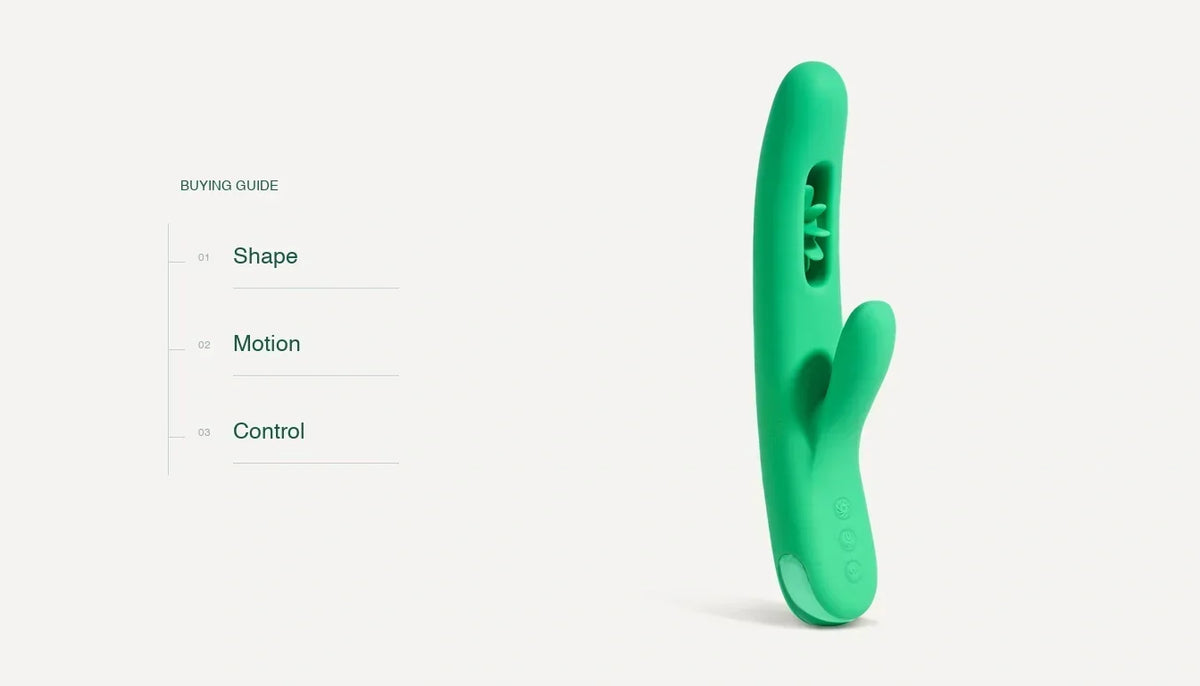

If you have seen the phrase "rabbit vibrator" while comparing toys, the name can sound oddly specific. The idea is simple: a rabbit vibrator is a dual-contact vibrator with one part designed for internal use and a second arm designed to rest near the clitoral area.
That two-part shape is what makes the category different from a regular vibrator, a wand, or a simple G-spot toy. It is not just about adding more intensity. It is about how two points of contact line up with your body, how the shape moves, and how much control you have over pressure, rhythm, and comfort.
This guide explains what a rabbit vibrator is, how it works, and what to know before deciding whether this type of design fits what you want.
What is a rabbit vibrator?
A rabbit vibrator usually has two main parts:
- An internal section, often curved or shaped for vaginal use.
- An external arm, positioned to make contact near the clitoral area.
Together, those parts create dual stimulation. Instead of using one toy internally and another externally, the two contact points are built into one product.
Different designs can feel very different. Some use vibration in both sections. Some add rotating, pulsing, thrusting, or spinning-style movement. Some have a firm external arm, while others are more flexible. Small details such as angle, length, motor placement, and control layout can change the experience more than the product name suggests.
That is why fit matters. A rabbit vibrator tends to work better when the internal shape and external arm both feel comfortable for your body. If either part feels off, more power is rarely the answer. Usually, the better move is to adjust the angle, lower the setting, or choose a shape that suits you more naturally.
How does a rabbit vibrator work?
A rabbit vibrator works by combining internal contact with external contact. The internal section creates sensation inside the body, while the external arm adds contact outside the body. Depending on the design, each section may vibrate, move, rotate, pulse, or combine several motion types.
The key point is alignment.
For the external arm to feel comfortable, it needs to rest where your body wants it to rest. For the internal section to feel natural, the curve and angle need to work with your position. When both parts line up well, the experience can feel coordinated. When they do not, the product can feel distracting even if the motor is strong.
When comparing rabbit-style designs, look beyond the longest feature list. Pay attention to:
- Shape and curve.
- External arm length.
- Flexibility.
- Control style.
- Motion type.
- Overall size.
- Whether you can start low and adjust gradually.
The right fit is usually the one that gives you room to relax and make small adjustments.
How is it different from a regular vibrator?
A regular vibrator usually has one main contact point. Depending on its shape, it may be used externally, internally, or in different positions, but it is not built around two dedicated contact points at the same time.
A rabbit vibrator is more structured. It is designed for internal and external contact together, which can be useful if you already know you like that kind of combination or want to explore it with one product instead of two.
That structure is also the tradeoff. A simple vibrator can be easier to move freely. A rabbit vibrator asks more from the fit: the curve, arm placement, and angle all matter. If the two parts do not land where you want them, increasing intensity may not solve the problem.
Think of the difference this way:
- A regular vibrator is often easier to place in different ways.
- A rabbit vibrator can feel more coordinated when the shape fits well.
- A rabbit vibrator makes alignment and control more important.
Neither format is automatically better. They are designed for different needs.
Rabbit vibrator vs. G-spot vibrator: what is the difference?
A G-spot vibrator usually focuses on internal stimulation. It often has a curved shaft or angled tip designed to apply pressure toward the front wall of the vagina. Some designs are slim and simple; others are broader, more flexible, or more textured.
A rabbit vibrator may also include a curved internal section, but it adds the external arm. The simple difference is:
- A G-spot vibrator mainly focuses on internal contact.
- A rabbit vibrator combines internal contact with external contact.
If your main question is how to choose the right internal shape, a G-spot vibrator guide may be more useful. If your question is how two contact points work together, this category is the better place to start.
The two categories can overlap. Some rabbit vibrators are also designed with G-spot contact in mind. In that case, the question becomes less about the label and more about the experience you want: one focused contact point, or two coordinated contact points.
What should you know before using one for the first time?
If you are new to this category, start with comfort and control. You do not need to use every setting right away, and both contact points do not need to feel fully aligned immediately.
Before first use, ask a few practical questions:
- Do I want internal and external contact at the same time?
- Do I prefer a flexible product or a more structured shape?
- Do I want vibration, moving contact, or both?
- Can I start on a low setting and adjust slowly?
- Does the external arm look like it can rest comfortably for my body?
Avoid rushing the fit. Begin with the lowest comfortable setting, use lubricant if appropriate for the product material, and pause if the angle or pressure feels off. Small position changes often matter more than turning intensity up.
For a more detailed routine, read How to Use a Rabbit Vibrator for the First Time.
Where spinning or rotating motion fits in
Some rabbit vibrators rely on standard vibration. Others add rotating, spinning, or directional movement. These motions are not just different labels for the same sensation.
Vibration is usually felt through frequency and intensity. Rotating or spinning motion adds directional contact, which may feel more like repeated movement or sweeping pressure, depending on the design.
That difference matters if you are deciding what kind of sensation sounds more natural to you. Some people want familiar vibration. Others want a more guided sense of motion. A moving-contact design may not feel like "more power"; it may feel like a different rhythm.
For a deeper comparison, read Spinning vs. Vibration: What Actually Feels Different.
When to compare VINDANI and VELORA
Once the category makes sense, the next question is about fit. Do you want a fuller, more structured rabbit-style design, or something smaller and more flexible?
For VIVIFIE, VINDANI and VELORA represent different ways to approach Windmill-style motion. VINDANI is the fuller signature Windmill rabbit experience. VELORA is smaller and more flexible, with a removable side arm.
That distinction can help you compare by shape, control, and contact instead of trying to choose from features alone.
If you are deciding between the two, read VINDANI vs. VELORA: Which One Should You Choose?.
FAQ
Is a rabbit vibrator only for beginners?
No. It is a product category, not a skill level. Some designs are simple; others have more structure, motion, or controls. The better question is whether the shape and contact points fit what you want.
Does a rabbit vibrator reach both areas at once?
Not for every body and not in every position. Rabbit-style designs are made for dual contact, but fit depends on shape, external arm placement, angle, and anatomy. If both contact points do not line up immediately, repositioning may help.
Is rotating motion the same as vibration?
No. Vibration is usually based on frequency and intensity. Rotating or spinning motion adds directional movement. Some products use one type of motion, while others combine them.
How do I know which shape is right for me?
Look at the curve, size, flexibility, external arm placement, and control style. If you are new to the category, prioritize comfort, low settings, and adjustability over the longest feature list.
A simple way to think about it
A rabbit vibrator is a dual-contact design. The internal section and external arm work together, but the experience depends on shape, alignment, motion, and control.
If you are still learning the category, start with four questions:
- What kind of contact do I want?
- Do I want vibration, motion, or both?
- Do I prefer a fuller structure or a more flexible design?
- Do I want a first-time routine before choosing a product?
From there, you can move into more specific comparisons without guessing.